
We are happy to announce the launch of Gravity Flow 3.1.
3.1 continues the quality of life work we started in 3.0, with two features built to make workflow management faster and less repetitive.
There’s a new Choice Routing step that branches your workflow automatically, based on choices the sender makes via dropdowns or radio fields. And you’ll find a new Send to Step bulk action that lets you move multiple entries through your workflow at once. Plus some minor improvements we’ll make below.
Read on to find out what’s new in Gravity Flow 3.1, and how to update today…
Introducing Gravity Flow 3.1
Gravity Flow 3.0 aims to smooth out the everyday hurdles of building and managing workflows – 3.1 keeps that in check!
This release is smaller and more focused, but two key features address two of the most repetitive jobs in Flow: setting up branching logic, and moving entries once the workflow is active.
Both save clicks, and both get better as your forms and workflows evolve.
New Preferred Routing Step: Branch your workflow automatically
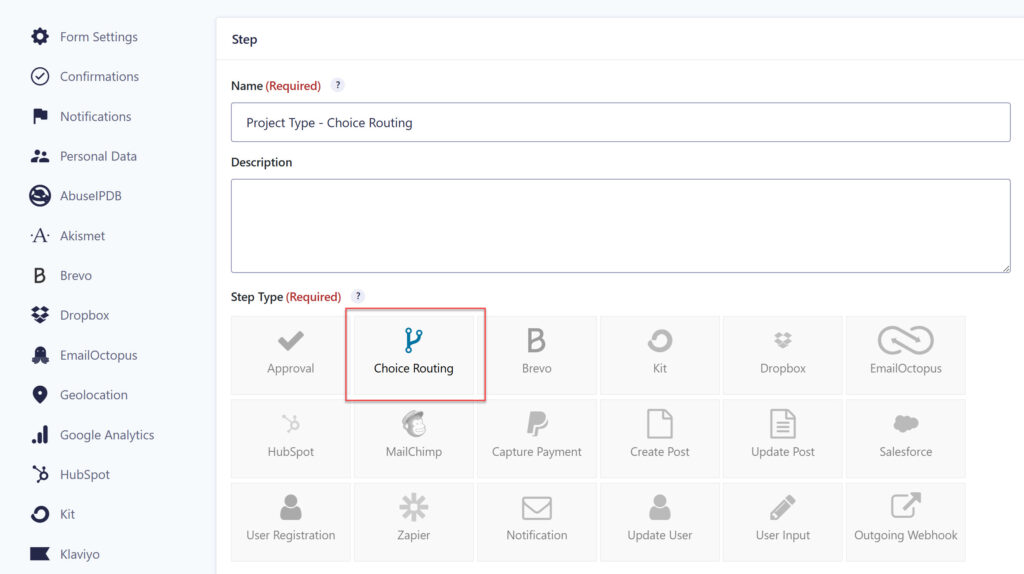
Gravity Flow can already create branching workflows. The problem is that this usually means a lot of conditional logic that has to be set up and maintained.
This feedback from early 3.1 beta testers summarizes just one of the many solutions our customers have previously used…
“I’m looking forward to the new Selected Routing step! For years, I’ve been “fake” that functionality by using dummy Notification steps that don’t have a selected Notification. I create a conditional dummy Notification step and set the Next Step to wherever I want the flow to flow if the conditions are met.”
Fortunately, the new Preferred Routing step gives us a simpler and more flexible way to set up future routing logic.
Using Preferred Routing
With Gravity Flow 3.1, you can now send entries to different steps based on the options the sender selects in the dropdown or radio field. When an entry reaches that step, Flow checks the selection and sends it to a suitable route, without requiring user interaction.
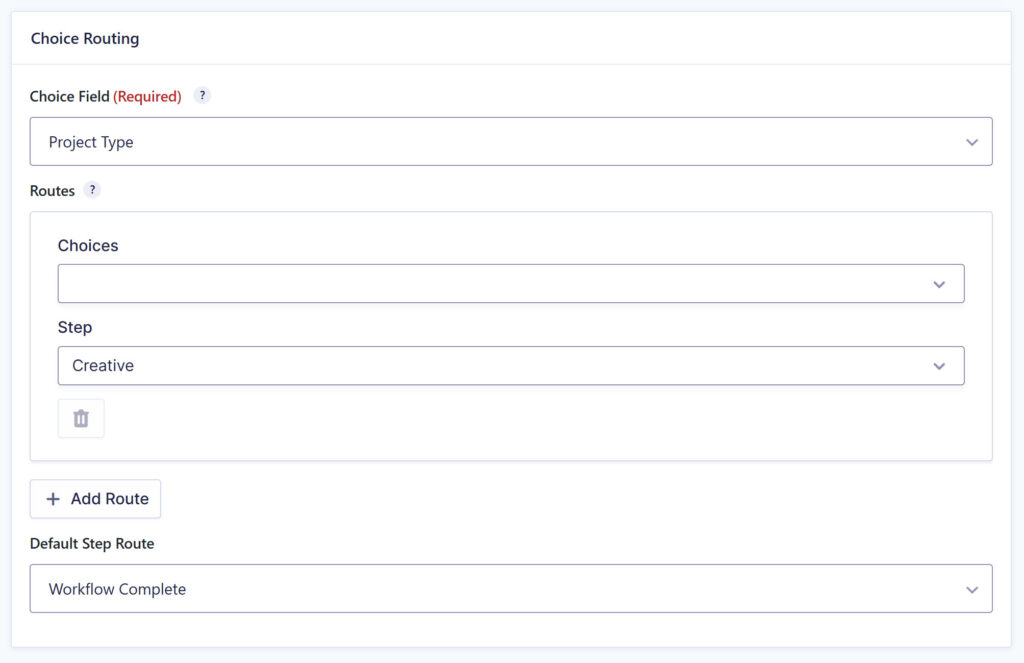
During setup, you can create as many routes as you need, and each route can send one or more options to the same step.
Importantly, each selection can only belong to one route, so there’s no overlap, and your routing remains easy to manage as the form evolves.
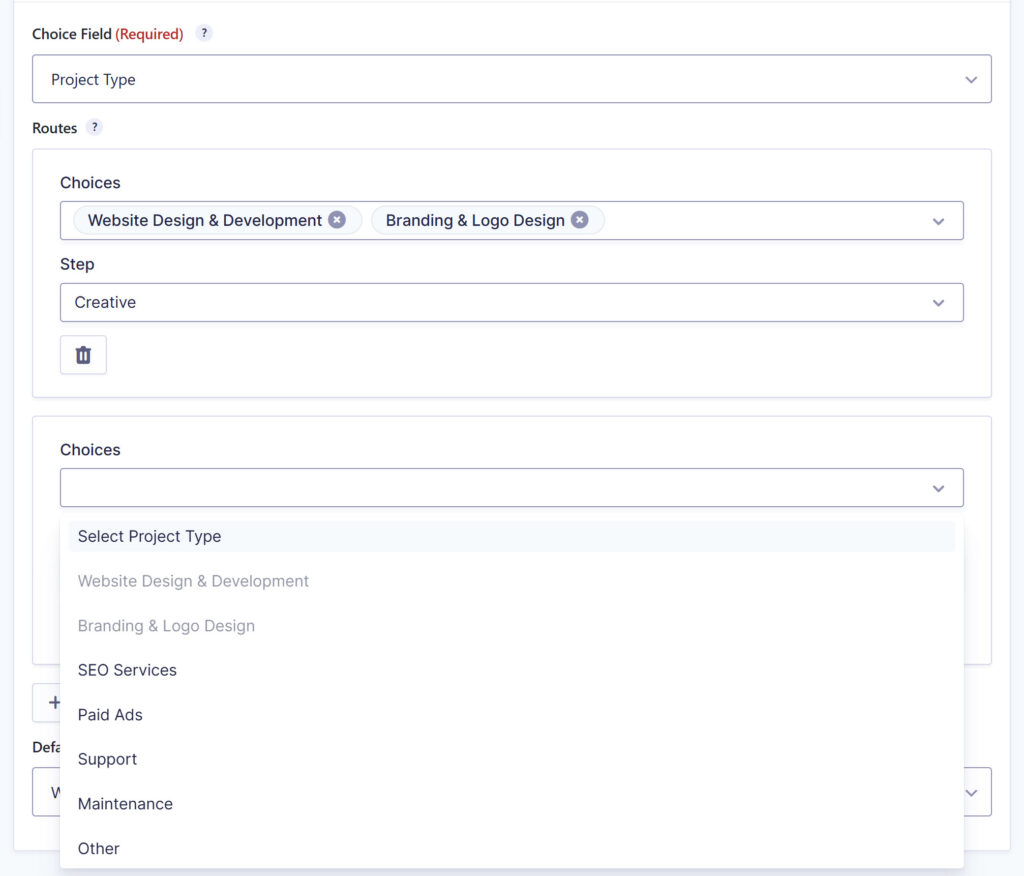
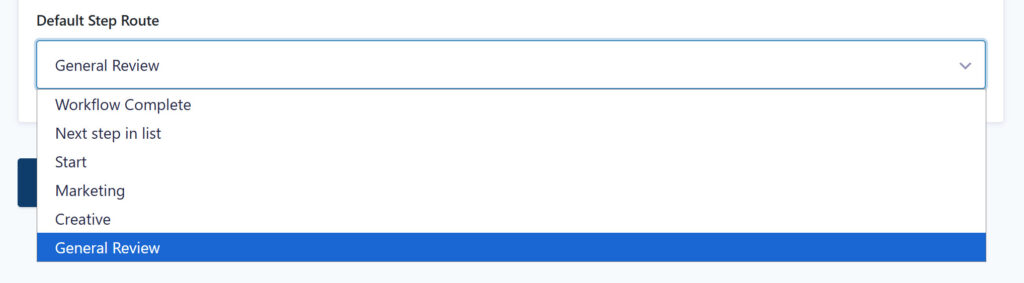
If an entry comes with a choice that doesn’t match one of your routes, the Default Step Route is there to catch it, so nothing slips through the cracks.
Gravity Flow also records every routing decision in the entry timeline, so you can always see which path the entry took and why.
General example
For this example, the agency uses a single intake form for new client requests, and each project type needs to reach a specific team.
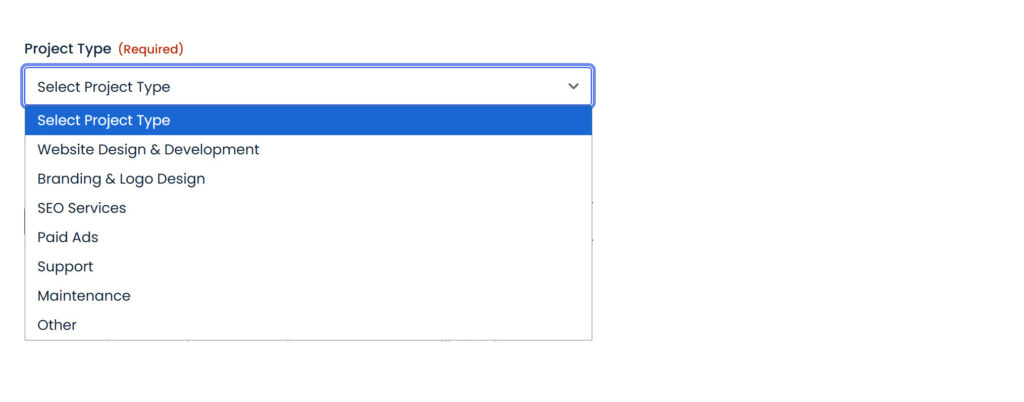
By using Conditional Routing you can:
– Refer Website Design and Branding questions to the Creative team.
– Send SEO and Paid Advertising requests to the Marketing team.
– Direct the Support and Maintenance options to the Support team.
– Anything that doesn’t match will be returned to the Overview step.
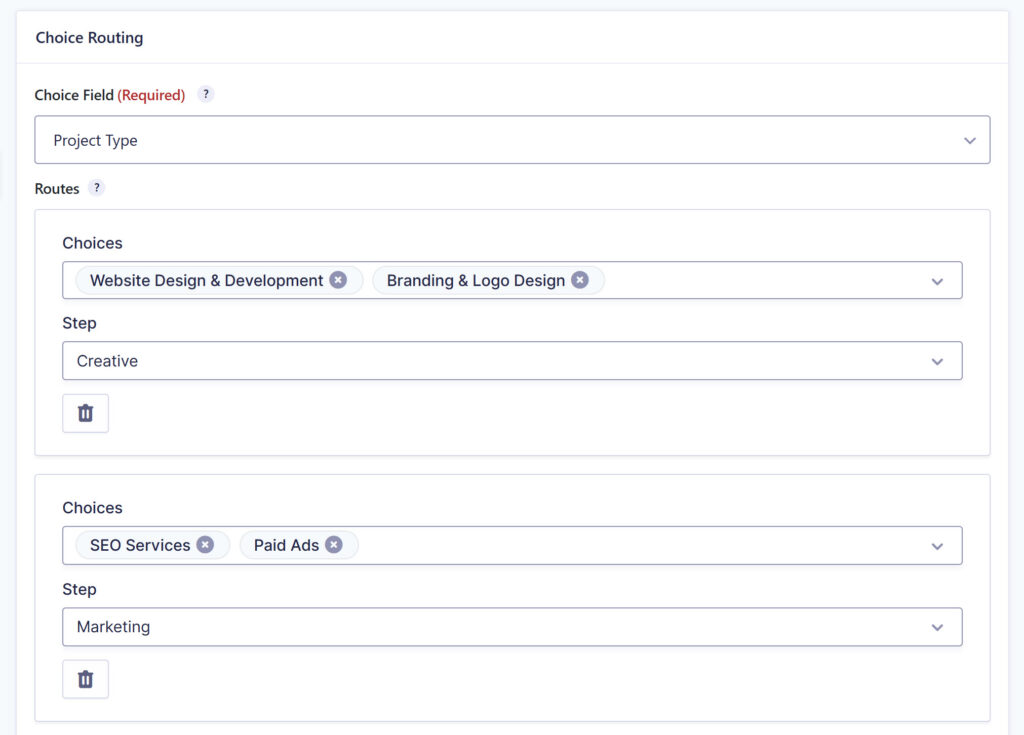
In the future, when new project types are added to the form, only the Route table needs to be updated – no new steps, no restructuring.
For more information about the Preferred Routing step, see the documentation.
Bulk Actions: Send multiple entries to one step at once
Moving entries through the workflow by hand, one at a time, doesn’t matter if you have a few. Across a large number of entries, it gets old quickly.
With Gravity Flow 3.1, you’ll find a new Send to Step bulk action, which lets you select multiple entries and send them to a specific step in one action.
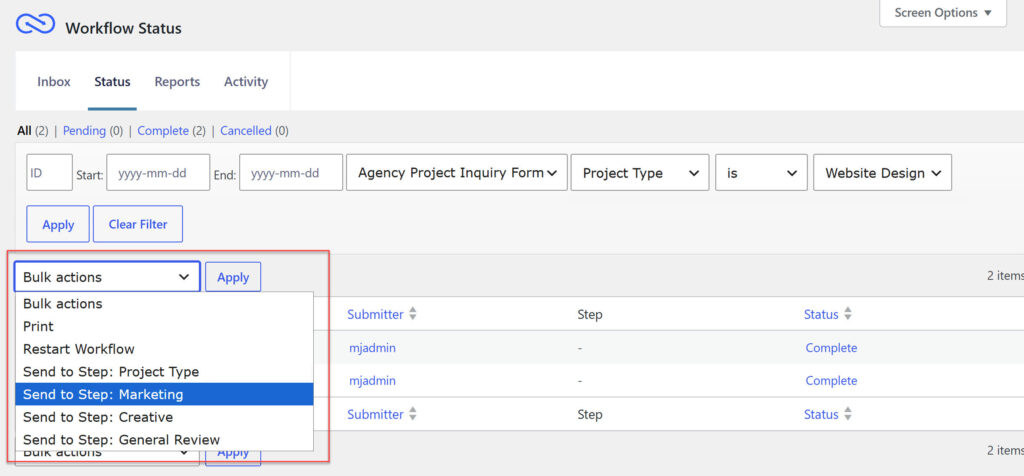
If a batch of entries is stuck awaiting approval that’s already been handled elsewhere, or you need to push a batch of posts back to a User Input step for another view, simply select them in bulk, select the step, and Flow moves them all at once.
The available Send to Step options depend on the form, as each form has its own set of steps. Therefore, this action is available when the Status screen is filtered to a single form.
You’ll also find the same Send to Step action in the Gravity Flow Status block, so you can manage entries this way from the front end, not just the admin.
For more information about the new Send to Step bulk action, see the Status page and the Blocking documentation.
More in 3.1
In addition to the two major features, 3.1 includes some improvements that are worth making.
- Background Notification Support – Flow now supports the Background Notification feature introduced in Gravity Forms 2.10. Notifications can be processed in the background, making form submissions feel faster for your users.
- Block API v3 for Workflow Blocks – Gravity Flow blocks are now compatible with the WordPress Block API v3, along the same lines of work in Gravity Forms 3.0. That means better compatibility with current themes and a smoother experience embedding your workflow blocks in the block editor.
- Improved GravityView integration – Flow workflow approval fields are now available in the GravityView field selector on the Single Entry and Multiple Entry configuration tabs, and we’ve removed some deprecated filter warnings on the Workflow Details and Workflow Approval links. Thanks to the team at GravityKit for their help here.
- Gravity Forms 3.0 Compatibility – With the Gravity Forms 3.0 beta now open for testing, we’ve ensured the Assign To and Date Picker components display correctly when you run Gravity Forms 3.0.0 and later.
Update to Gravity Flow 3.1
Gravity Flow 3.1 is now available to all customers with an active license.
If you have automatic updates enabled, you’re all set. If not, go to your WordPress dashboard, go to your plugins page, and click to update to version 3.1. You can also download the latest version from within your Gravity Flow Account.
New to Gravity Flow? Visit our pricing page to get started, or sign up for a personalized demo of Gravity Flow 3.1 to see it in action.
Have questions about new features or how to update? Our Support Team is happy to help.
Gravity Flow 3.1 changelog
- Added Send to Step to Bulk Action option in the Workflow Status screen. Only accessible when filtered to a specific form.
- Added a new step type, Selection Routing, which routes the workflow to a different next step based on the value of the selected form field (dropdown or radio).
- Added support for the Background Notification feature available with Gravity Forms 2.10.0 and later.
- Updated the workflow fields and detail/edit entry pages for compatibility with changes to GF_Field::get_value_entry_detail() and GFCommon::get_lead_field_display() in Gravity Forms 2.9.29.
- Updated Workflow Blocks to be compatible with WordPress Block API v3.
- Updated the GravityView integration to make the Flow workflow approval field available in the GravityView field selector on the Single Entry configuration tab as well as the Multiple Entry tab. Credit: team at GravityKit.
- Updated the GravityView integration to address deprecated filter warnings for the Workflow Detail Link and Workflow Approval Link views.
- Fixed an issue where Request Field Value settings remained visible in the Exit Webhook step when switching Request Body to Raw Request.
- Fixed some button display issues on the admin entry details page for WordPress 7.0-beta.
- Fixed an issue where field-level conditional logic was not respected when using the “selected_field” display option.
- Fixed an issue where blocks for the Gravity Flow extension did not appear in the block editor when viewing post.php.
- Fixed an issue where count_users() could run on every page load.
- Fixed an issue where discarded workflow entries could still be viewed or updated via a direct link.
- Fixed an issue where the approval step could not be completed when AJAX sending was enabled.
- Fixed an issue where editing an Update User workflow step without sufficient permissions displayed the same error message twice.
- Fixed PHP fatal error when conditional logic evaluates the condition of a date field.
- Fixed an issue where the Assign To and Date Picker components were not rendering when using Gravity Forms 3.0.0 and later.
- API: Fixed REST API V2 sending to step endpoints rejecting entries without an active workflow step (for example, canceled or completed).
- API: Added new Dynamic_choice_map setting type (Multiple to Single). A general settings field that maps multiple “option” choices to one “target” choice per row, with configurable column labels. Used by the Preferred Routing step for routing rules.

Bulletin
If you want to stay up to date on what’s happening on the blog, sign up for the Gravity Forms newsletter!
“*” indicates a required field
PakarPBN
A Private Blog Network (PBN) is a collection of websites that are controlled by a single individual or organization and used primarily to build backlinks to a “money site” in order to influence its ranking in search engines such as Google. The core idea behind a PBN is based on the importance of backlinks in Google’s ranking algorithm. Since Google views backlinks as signals of authority and trust, some website owners attempt to artificially create these signals through a controlled network of sites.
In a typical PBN setup, the owner acquires expired or aged domains that already have existing authority, backlinks, and history. These domains are rebuilt with new content and hosted separately, often using different IP addresses, hosting providers, themes, and ownership details to make them appear unrelated. Within the content published on these sites, links are strategically placed that point to the main website the owner wants to rank higher. By doing this, the owner attempts to pass link equity (also known as “link juice”) from the PBN sites to the target website.
The purpose of a PBN is to give the impression that the target website is naturally earning links from multiple independent sources. If done effectively, this can temporarily improve keyword rankings, increase organic visibility, and drive more traffic from search results.
Jasa Backlink
Download Anime Batch