
The hardest part about sponsoring an event isn’t getting a yes. That’s everything after that. Sponsorships are relationships that last for months, but most nonprofits run them with development teams of one or two people, volunteer party committees, spreadsheets, and inboxes. Commitments are made, and then the details spread.
Creating the sponsorship form itself is the quick part, and we’ve covered it before: the event sponsorship form template gives you levels, prices, and card payments straight away, and the sponsorship form getting started guide explains the setup.
This post is about everything that needs to be set in motion afterward, using Gravity Flow and the Square Add-On: tracking who’s paying, collecting logos without having to chase, delivering every benefit you’re selling, and getting back in front of sponsors before next year’s budget is set.
Gravity and Square Shapes has teamed up to offer an exclusive promotion for new Square customers — enjoy free processing fees for up to 180 days!
Here’s how it works:
- Free Payment Processing – Get $5,000 in credit card transactions processed for free in your first time 180 days. After that, Square’s standard fees apply.
- $20 off Square Hardware – Receive a $20 off on Square hardware after you sign up.
To take advantage of this promotion, simply sign up for a Square account using this link and start processing payments at no additional cost.
Five places, in practice:
- Know who is committed and who is getting paid. Spreadsheets say one thing, bank statements say another, and the truth is split between the development director’s and treasurer’s inboxes.
- Collecting money. Card payments are easy but no one regulates them; the invoice came out late and sat in the company’s accounts payable queue for six weeks.
- Chase assets. Logo, program list, guest names for their tables. Everything is promised, nothing is delivered, and the printing deadline has not changed.
- Deliver what you sell. The gold tier includes three social posts. Did that happen? Nobody writes it down, and undelivered benefits are the reason why sponsors don’t return.
- Update. Ten months of silence, then a scramble for demand three weeks after sponsors set next year’s giving budget.
The form fixes the first two directly. The accompanying workflow fixes the rest. Overall, the division of labor is: Gravity Forms is the form and records each sponsorship, Square Add-On accepts payments within that form, Gravity Flow runs everything that happens after submission, and Gravity SMTP makes sure the emails go through.
Forms of commitment (Gravity Forms)
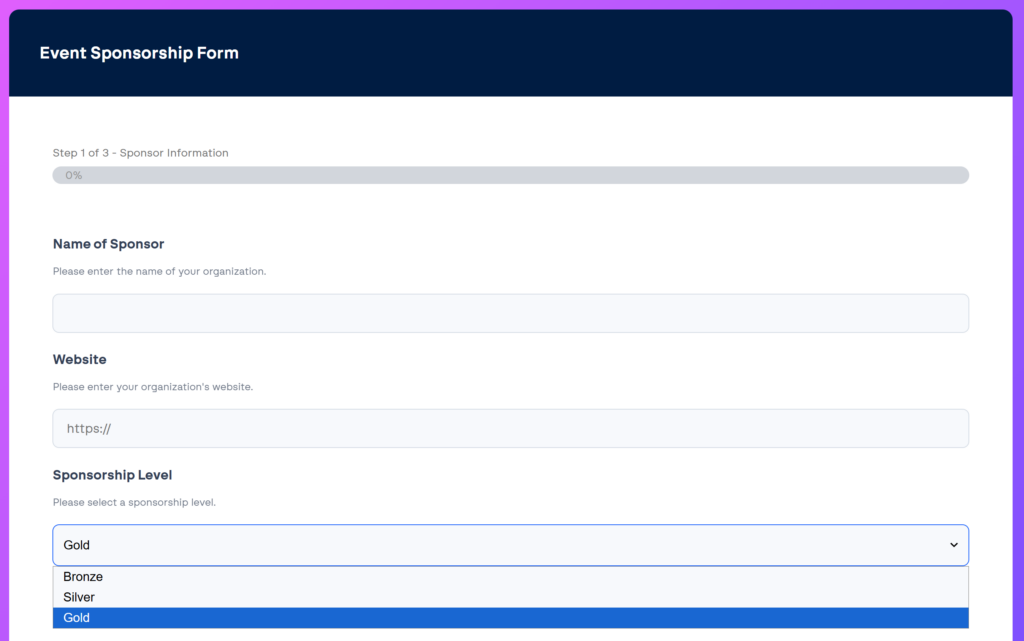
Start with an event sponsorship template, then create three additions that are important to nonprofit fundraising.
The level of sold-out sponsorships says so. The sponsorship inventory is real: there is one sponsor who gives, maybe ten gold tables. Gravity Forms Inventory, a Certified Add-On from Gravity Wiz, limits the number of times each option can be selected, deactivates a level after it has been taken, and can show how many spots are remaining. “Only 2 gold tables left” on the form instantly generates more sales than any other follow-up email.
Choice of payment method. Local businesses sponsoring community fundraisers will be happy to pay by card on the spot. Banks and hospital systems cannot; Their accounts payable process requires invoices, W-9s, sometimes vendor forms. One conditional field respects both realities, and both paths are in the same workflow.
Good road. Restaurants donating their catering and breweries providing bars are also sponsors, often at rates that will cost some of the cash levels. The “cash or in kind” branch allows them to describe what they are offering and skip payment, so they get the same confirmation, same asset collection, and same acknowledgment as everyone else, instead of living in separate email chains.
One thing not to add: columns for logos, ad copy, or table guest lists. The person giving the money is often not the person who has those things, and any additional areas at this stage require you to pay a commitment. Workflow collects the rest at the right time, from the right people.
Get paid without awkward follow-ups (Square Add-On)
The Square Add-On connects your form to your Square account: the card field is on the form itself, and the payment process is with submission. Three pay lines cover most events:
- Card upon delivery. For the standard level, the sponsor pays according to its commitment. Commit and pay in the same minute, and the entry says so.
- Card with signature first. If a level requires approval before being confirmed (a sponsor present, or a request with a special request attached), the Authorization Only setting on the Square feed will validate the card and hold the amount without charging a fee. The executive director approves, you take payment from the entry, and no card is charged for discontinued sponsorship. Catch it immediately: authorization expires in a few days, in the square Collection window.
- Invoice. The invoice payer bypasses the card field and enters the workflow marked as a pending invoice. Finance, whether a staff member or board treasurer, sends an invoice as a workflow step, and entries track the state until payment is confirmed.
The question mark in the “paid?” columns no longer exist, because the entry list is the answer: every sponsor, their level, and their payment status on one screen. When the board asks how sponsorship is tracking against targets, that screen is the report.
Logo chasing, automatic (Gravity Flow)
This is the part that pays for the entire building. Once a sponsor is confirmed, Gravity Flow can assign steps directly to the sponsor’s email address. No WordPress account, no login. Sponsor contacts get an email with a link to a page on your site asking what their level requires:
- The logo, with accepted file formats is applied by the upload field
- Program list text, with character limits that match your program template
- Guest name, if the level includes tables
Then the workflow that your gala committee currently does by hand:
- Set due dates related to your printing deadlines.
- Schedule a reminder for a week in advance, and another for two days in advance.
- If the assets still don’t arrive, the move escalates to the event lead, who now has a short list of who to contact instead of a mental note to “check the logo at some point.”
Volunteers get their night back, and no one has to send a third awkward push to the donor.
File format points have their own value. A file upload field that accepts only vector and high-resolution formats prevents the issue of blurry screenshots at the source. The sponsor’s marketing staff knows exactly what to send because the form tells them so, and your designer never opens a 40 kilobyte JPEG again.
Delivering what you sell (Gravity Flow)
The entry is now a single record of sponsorship: level, amount, payment status, assets, guest names, their respective arrival dates. It’s the notes that make fulfillment manageable.
Add a checklist step assigned to whoever owns the delivery:
- The logo is placed on the program
- The banner is confirmed with the venue
- Social posts are scheduled
- Printed table cards
It takes minutes to set up and it closes the most expensive gap in event sponsorship, as sponsors who pay for visibility and don’t get it all won’t complain. They’ll politely decline next year, and you’ll never know why.
One specific non-profit note is here. In the US, how you identify a sponsor can have tax consequences: recognition (the sponsor’s name and logo) is treated differently from advertising (endorsements, pricing, calls to action), and the wrong type of recognition can turn tax-free sponsorship revenue into taxable advertising revenue. Your accountant or gift acceptance policy determines the limit. Workflow tasks are smaller but useful: entries record exactly what acknowledgment was promised and delivered, so the answer is there if the question arises.
Updates, scheduled before you forget (Gravity Flow and Gravity SMTP)
After the event, two things are given to each sponsor:
- Thank you with real numbers. Attendance, funds raised, what support they provide to the people you serve. Sponsors have to justify this spend to someone, and you’re the one who can provide that justification to them. Gravity SMTP is worth implementing so that these messages, and any previous confirmations, actually make it to the inbox; a thank you in the spam folder is worse than nothing at all.
- Scheduled steps that bring back sponsors when planning begins for next year. This is something that almost no one makes. Gravity Flow steps can drag on for months, so entries from this year’s gala reappear in the development director’s inbox the following spring with a whole history attached: what level they took, how much they paid, did their assets arrive on time, how the relationship went.
This is important because corporate sponsorship of nonprofits is a local market: the same businesses are sought after by every organization in town. The sponsors who come back are the ones who are taken care of: given a proper thank you, shown what the money is for, and asked again before the budget is discussed. Renewals are the cheapest sponsorship revenue ever, and the only reliable way to lose them is to simply sit still, which is the result of a ten-month hiatus with no system in place.
Who remains human
The prospectus still has to make the case. Board members are still opening doors to companies that staff don’t know about. Sponsorships are still negotiated over lunch, because at that level the relationship is the product. None of this is hard work, and it shouldn’t be.
What workflows replace are the mechanisms around those conversations: the tracking, the chasing, the uncertainty of invoicing, the missed updates. That’s the work currently done at night, from spreadsheets, by whoever cares most. Wake up once, before this year’s event, and next year’s sponsors fall into a system that already knows them.
If your organization is a registered nonprofit, you can get started with all the functionality in Gravity Forms by purchasing a Gravity Forms Nonprofit license.
Additionally, go to the Gravity Flow pricing page to browse license types and purchase add-ons.

Bulletin
If you want to stay up to date on what’s happening on the blog, sign up for the Gravity Forms newsletter!
“*” indicates a required field
PakarPBN
A Private Blog Network (PBN) is a collection of websites that are controlled by a single individual or organization and used primarily to build backlinks to a “money site” in order to influence its ranking in search engines such as Google. The core idea behind a PBN is based on the importance of backlinks in Google’s ranking algorithm. Since Google views backlinks as signals of authority and trust, some website owners attempt to artificially create these signals through a controlled network of sites.
In a typical PBN setup, the owner acquires expired or aged domains that already have existing authority, backlinks, and history. These domains are rebuilt with new content and hosted separately, often using different IP addresses, hosting providers, themes, and ownership details to make them appear unrelated. Within the content published on these sites, links are strategically placed that point to the main website the owner wants to rank higher. By doing this, the owner attempts to pass link equity (also known as “link juice”) from the PBN sites to the target website.
The purpose of a PBN is to give the impression that the target website is naturally earning links from multiple independent sources. If done effectively, this can temporarily improve keyword rankings, increase organic visibility, and drive more traffic from search results.
Jasa Backlink
Download Anime Batch